
This article reflects trade developments following the announcement of the India–UK Comprehensive Economic and Trade Agreement (CETA) in late July 2025. Market impacts will depend on implementation timelines, rules of origin, sanitary compliance, and sustainability requirements.
A trade breakthrough with uneven outcomes
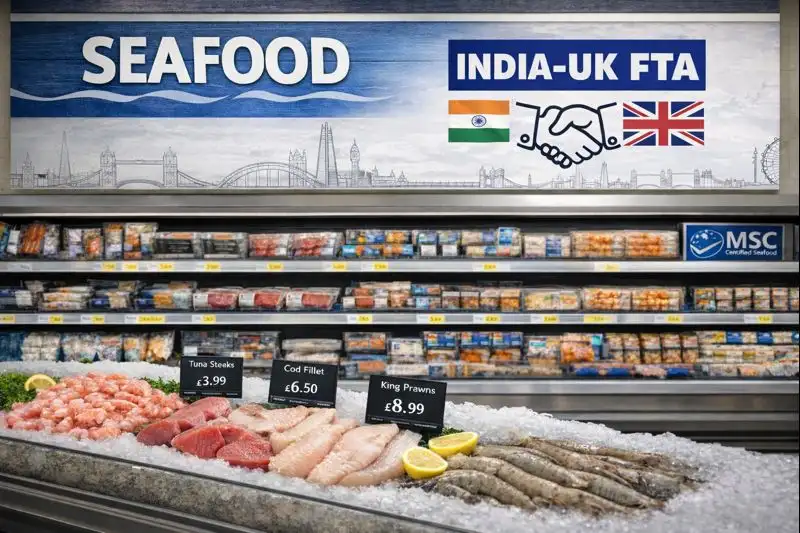
The announcement of the India–UK Comprehensive Economic and Trade Agreement at the end of July 2025 marked a significant shift in bilateral seafood trade, removing long-standing tariff barriers that had constrained India’s competitiveness in the UK market. With duties on Indian seafood exports eliminated, Indian suppliers effectively gained parity with established exporting nations such as Vietnam and Thailand, many of which had previously benefited from preferential access. Early signals from the market suggest that the agreement is already influencing sourcing discussions among UK importers, particularly in categories where India has scale, experience, and established supply chains. However, the benefits of tariff liberalisation are not evenly distributed across seafood categories, and early momentum has been highly uneven.
Shrimp has emerged as the most immediate beneficiary of the agreement, reflecting India’s strength in aquaculture, processing capacity, and export readiness. Tuna, despite being one of the most widely consumed seafood products in the UK, continues to face structural barriers related to product format, sustainability certification, and entrenched competition. These constraints limit the extent to which tariff removal alone can unlock new market access, highlighting the distinction between policy access and practical market readiness.
The UK seafood market. Scale and selectivity
According to Seafish, the United Kingdom remains one of Europe’s largest seafood import markets, importing approximately €3.8 billion worth of seafood in 2024 across close to 790,000 tonnes of product. Tuna, cod, salmon, shrimp and prawns, and haddock dominate import volumes, underscoring both the scale and diversity of UK seafood consumption. A recent Seafish market insight report further highlights that tuna and warm-water prawns rank among the top five seafood products in the UK retail market, reflecting strong and consistent consumer demand across both ambient and frozen segments.
For India, warm-water shrimp and tuna are particularly relevant categories given domestic production capacity and access to fishing grounds. However, the UK market is defined not only by volume demand, but by increasingly strict requirements related to sustainability certification, traceability, product format, and retail readiness. These criteria play a decisive role in determining which suppliers are able to move beyond opportunistic trade into long-term retail and foodservice supply relationships.
India’s current position in the UK
India accounts for approximately 8 percent of global seafood production and is the world’s second-largest exporter of farmed shrimp, according to the Ministry of Fisheries, Government of India. Despite this global scale, India’s share of UK seafood imports remains limited at approximately 2.25 percent, as indicated in Government of India trade disclosures. This gap reflects historical tariff disadvantages as well as structural mismatches between India’s export profile and UK market requirements.
Recent MPEDA export data illustrates the concentration of Indian seafood exports to the UK, with total marine exports valued at approximately US$100–105 million, of which frozen shrimp accounts for roughly US$80 million and represents the majority of trade value. Prior to the implementation of CETA, Indian seafood exports faced tariffs of up to 8.5 percent, reducing price competitiveness relative to duty-free suppliers. While the agreement removes this tariff barrier, it does not address challenges related to certification coverage, processing formats, or buyer expectations, all of which continue to shape market outcomes.
Shrimp. A category ready to scale
Under the new trade framework, most Indian shrimp products now enter the UK market at zero duty, immediately improving competitiveness in a market that remains sensitive to landed cost, supply reliability, and specification consistency. India’s shrimp sector benefits from a mature aquaculture ecosystem, extensive processing infrastructure, and long experience serving regulated export markets, allowing it to respond quickly to changing buyer requirements.
Industry estimates suggest that Indian marine exports to the UK could grow by 60 to 70 percent over the medium term, with shrimp expected to account for the majority of this expansion. For UK importers, the advantages are tangible, including reduced landed costs following tariff elimination, access to large and scalable supply volumes, and improved margin stability through longer-term sourcing arrangements.
Tuna. Tariff-free but not market-ready
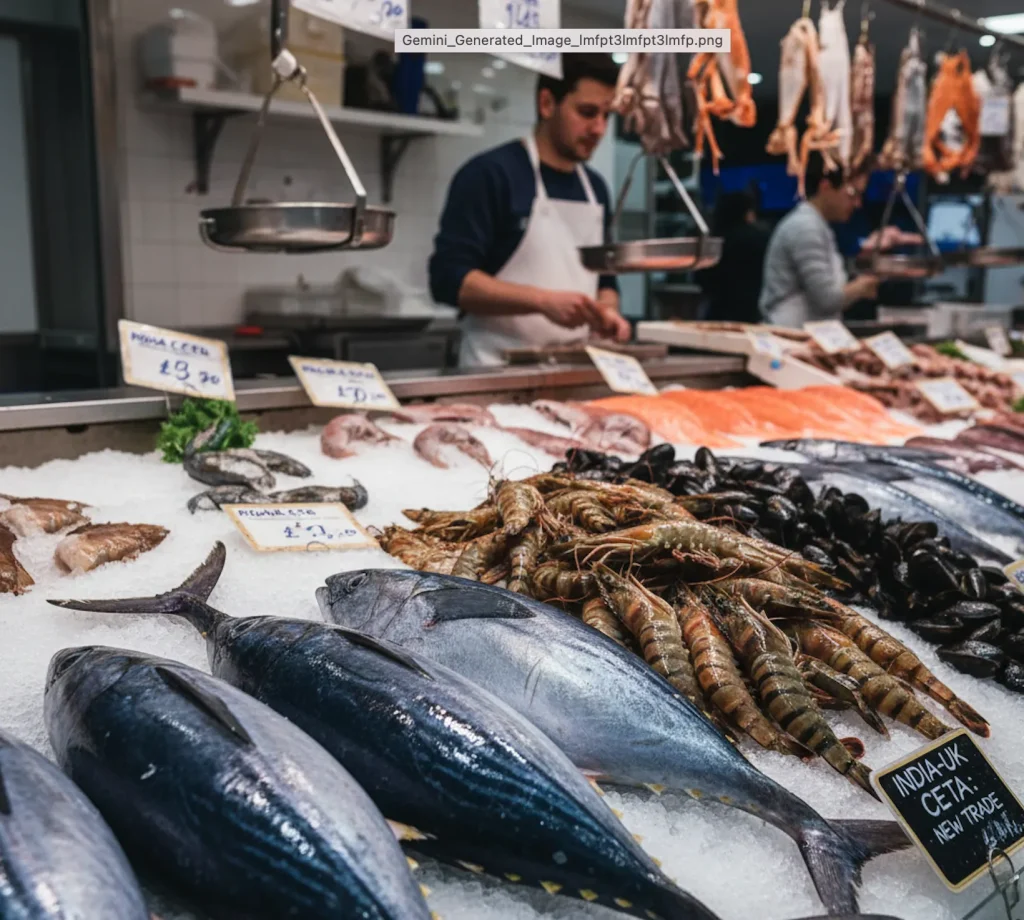
Tuna is one of the UK’s most consumed seafood categories and, in principle, should benefit from tariff liberalisation under CETA. In practice, however, three structural constraints continue to limit India’s participation in the UK tuna market, restricting the immediate impact of tariff removal.
First, product format remains a critical challenge. According to Seafish, more than 95 percent of tuna imported into the UK is in canned or preserved form, reflecting strong retail demand for shelf-stable products. India’s tuna exports, by contrast, remain focused on frozen loins and whole fish, while country lacks canning facilities.
Second, sustainability certification represents a significant barrier. As of 2025, no Indian tuna fishery holds MSC certification, which is a baseline requirement for most UK retail supply chains. Without certification or credible alternatives such as advanced Fishery Improvement Projects, access to supermarket and branded programs remains restricted regardless of tariff status.
Finally, competitive positioning continues to favour established processors, which combine certification, processing scale, brand recognition, and long-standing retail relationships. These factors continue to outweigh India’s raw material availability, resulting in limited short-term response in tuna exports to the UK despite tariff-free access.
Opportunities beyond shrimp and tuna
India’s seafood export potential extends beyond shrimp and tuna, encompassing squid, cuttlefish, octopus, crab, and a growing range of value-added products. These categories offer opportunities for diversification in the UK market, particularly in foodservice and specialist retail channels. However, realising this potential will require targeted investment in processing formats aligned with UK consumer preferences, stronger cold-chain management, and comprehensive sustainability and traceability documentation.
CETA provides a favourable policy environment for such development, but success will depend on execution rather than access alone. Exporters that invest in format innovation and compliance readiness are more likely to convert policy advantages into sustained market presence.
Sustainability as a market gatekeeper
While tariffs have been removed, sustainability has emerged as a decisive factor in UK seafood sourcing decisions. Retailers increasingly require MSC or ASC certification, participation in credible Fishery Improvement Projects, and full chain-of-custody traceability supported by transparent documentation. These requirements are now embedded in procurement policies rather than treated as optional attributes.
India has made progress through the expansion of FIPs and increased engagement with aquaculture certification initiatives. However, certification coverage remains limited relative to buyer expectations, reinforcing the importance of compliance and credibility as determinants of competitiveness in the UK market.
Outlook. From access to execution
The India–UK trade agreement provides a clear opportunity for Indian seafood exporters, but its long-term impact will be shaped by execution rather than policy alone. Key priorities include expanding processing capacity for value-added and shelf-stable formats, accelerating sustainability certification efforts, strengthening cold-chain and export readiness, and building collaborative relationships with UK buyers to align product development with market demand.
Shrimp is well positioned to capitalise on tariff-free access in the near term, supported by existing infrastructure and certification progress. Tuna and other categories will require longer-term structural investment to overcome format and sustainability constraints.
Opportunities Created, Execution Required
The India–UK CETA has lowered the tariff barrier, but it has not removed all barriers to trade. Shrimp, supported by infrastructure and growing compliance readiness, is already gaining momentum, while tuna remains constrained by processing, certification, and competitive dynamics. For India, the challenge is no longer market access, but market alignment. For UK buyers, the opportunity lies in engaging with suppliers that combine scale with compliance and long-term reliability.
The agreement marks a beginning rather than an endpoint. Its success will ultimately depend on how effectively India translates tariff-free access into retail-ready, compliant, and sustainable seafood supply.
References
Press Information Bureau, Government of India (2025).
India’s seafood export performance and production overview.
Seafish (2024).
UK seafood trade. End-of-year report 2024.
Marine Products Export Development Authority (MPEDA) (2025).
India–UK seafood trade and export statistics